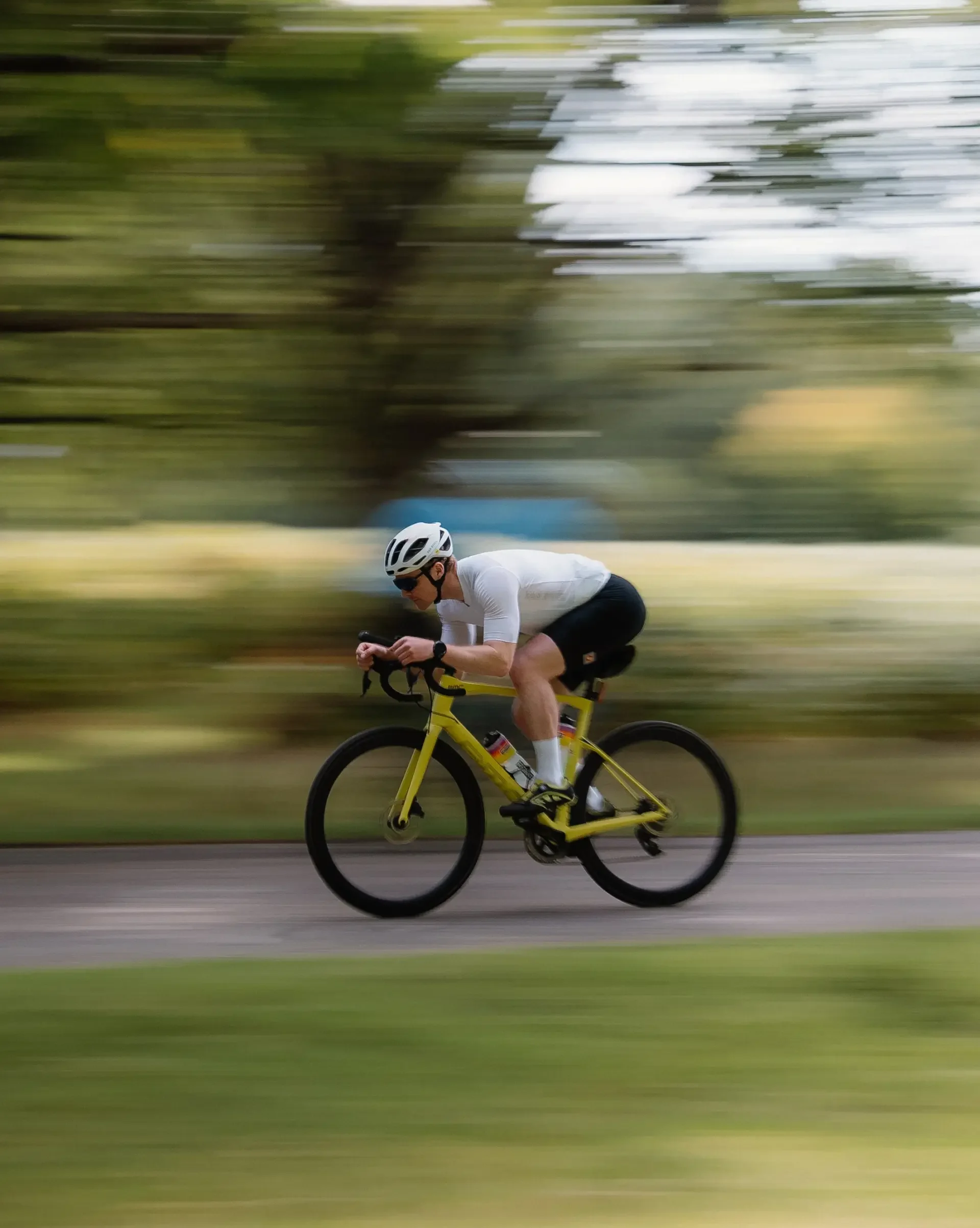
How to TRAIN and FUEL Like a Pro Cyclist
By Kieran Richardson + Tom McClure
Every July, the sporting calendar gets crowded. Wimbledon, the World Cup, T20 cricket, the Rugby Championship – there’s no shortage of things competing for your attention. But at OMNIA, one event stands out above the rest: the Tour de France.
It’s not just great TV. It’s arguably the single greatest test of human endurance in sport – riders holding efforts for six hours that most of us would struggle to hold for five minutes. And once you look past the spectacle, there’s a surprising amount that the everyday athlete – the person training around a job, a family, and a couple of gym sessions a week – can take from how the pros train, fuel, and recover.
Here’s what we picked out.
The Quiet Problem: Precision Training, Sloppy Fuelling
Most endurance athletes we work with are meticulous about their training. They know their FTP. They know their splits. They plan their blocks and obsess over marginal gains in aerodynamics or supplementation.
But nutrition? That’s often the part left to chance – figured out reactively, meal by meal, rather than planned with the same intent as the training itself.
The truth is, almost every athlete who starts working with a coach discovers the same thing first: they weren’t fuelling the active part of their day properly. This isn’t just an issue for people trying to lose weight — it shows up even in athletes whose body weight is stable, because being “fine” on paper can mask a training window that’s being wasted.
The window around a training session is a genuine opportunity to maximise the adaptation you get from it, and most people aren’t using it. Sometimes the difference isn’t subtle — a single fuelled session, done properly, can feel like a different body entirely. More power, more freshness, better recovery the next day. It’s one of the few things in sport that doesn’t need weeks of adaptation to notice — you can feel it in one session.
What Chronic Under-fuelling Looks Like:
Underfuelling rarely announces itself. More often it shows up as a performance plateau, recovery that never quite feels complete, or a training week where the wheels start to come off by Thursday.
Part of the problem is how energy needs get tracked. Static daily calorie targets – the kind you’d set once in a tracking app – don’t account for the fact that your energy needs change with your training load day to day. A heavy climbing day and a rest day are not the same day, nutritionally. Without adjusting for that, athletes end up unintentionally over- or under-fuelling, and it compounds over weeks and months.
This is where wearable and training data becomes genuinely useful – not for vanity metrics, but for giving you a realistic prescription for the day based on what you actually asked your body to do.
For context: this year, around 40% of Tour de France riders are using Hexis, the nutrition app OMNIA works with, to manage exactly this. Riders are posting their daily intake on social media, and the numbers are eye-watering — Jonas Vingegaard’s Hexis breakdown on one of the toughest mountain stages this year totalled around 8,500 calories, including 1,700g of carbohydrate, with breakfast alone accounting for over 300g of carbs. Most of us aren’t riding 180km with 4,000m of climbing, but the underlying principle scales down perfectly: fuel for the work you’re actually doing, not an arbitrary number.
Lighter Isn’t Always Faster
For years, the assumption in endurance sport has been that smaller equals faster. The Tour is quietly rewriting that idea.
Riders on some of the current generation of teams – the Norwegian squad Jonas Vingegaard rides for among them – have been getting visibly bigger and more muscular, and it hasn’t hurt their power-to-weight ratio. In some cases, peak power output has jumped by as much as 50%, from roughly 900 to 1,500 watts, which more than offsets the added muscle mass. The phrase that keeps coming up around these teams is “chase watts, not kilograms.”
For everyday athletes, this matters even more. Very few of us are earning a living from being the lightest possible version of ourselves. Most of us want to be strong enough to pick up our kids, resilient enough to withstand a fall, and fit enough to be no more than three or four months away from taking on a race – a Hyrox, a half marathon, a triathlon – at any given time.
There’s also a real cost to chasing “smaller” for its own sake, particularly for female athletes. Relative Energy Deficiency in Sport (REDS) remains far more common than people realise, even at recreational and university level, and its consequences – stress fractures, injury, stalled progress – often follow athletes for years. Letting go of the idea that lighter is always better tends to produce both healthier and faster athletes.
The pattern shows up consistently in coaching data too: athletes who focus on fuelling for the work required, rather than chasing a lower number on the scale, often end up gaining a bit of weight and muscle – and improving their endurance performance at the same time.
Should You Add Cycling To Training?
One of the more underrated lessons from the Tour is what cycling can do for athletes who primarily run.
Cycling is comparatively low-impact but still delivers a serious aerobic training effect, which makes it a useful tool for athletes managing injury history or high running volume. It’s entirely possible to run relatively low weekly mileage, supplement it with consistent cycling, and still hit strong running times – because the aerobic engine built on the bike carries over.
It’s also a lot more forgiving day-to-day. A two-hour run is a significant stress on the body and will usually be the main event of your day. A two-hour ride, at a comparable intensity, is far less fatiguing – you can finish it before breakfast and still train hard in the gym that afternoon. That makes it a genuinely useful tool for building volume without accumulating the same fatigue.
There’s also a cost myth worth debunking here: cycling doesn’t require an expensive bike, matching kit, or the latest gear you see on social media. A decent second-hand bike and budget kit is more than enough to get out, enjoy it, and get the training benefit – no top-end equipment required.
Bookend Your Rides With Intent.
Whether you’re new to cycling or already logging serious miles, the same nutrition principles apply as with any endurance session:
- Before: aim for at least ~30g of carbohydrate in the 30 minutes before you head out, or a fuller meal if time allows.
- During: once you’re past the one-hour mark, start taking on carbohydrate – a gel, a rice krispie square, dried fruit, or whatever you can tolerate.
- After: aim for roughly 1g of carbohydrate per kg of bodyweight alongside 20-40g of protein, plus fluids if it was a warm ride. A smoothie or chocolate milk works well if a full meal isn’t practical straight away.
One instructive number: on power meter data (not an estimated app figure, but a direct measure of work done), a long weekend ride can easily burn 1,500–2,000 calories above baseline – which for many athletes means their weekend long ride alone can push total energy needs from around 3,500–4,000 calories up to nearer 6,000. Underfuelling that kind of output doesn’t just cost you on the day — it leaves you depleted going into the next hard session.
The old cycling culture of “getting by” on a banana and a coffee for a three-hour ride might be survivable, but it’s rarely optimal – particularly if there’s a hard session or a strength day coming the next morning.
The Takeaway:
You don’t need to follow the Tour de France to take something from it. The core lessons hold regardless of sport or level:
- Train with precision, but fuel with the same precision – don’t leave nutrition to chance.
- Chase performance and strength, not an arbitrary number on the scale.
- Cross-training – particularly cycling for runners – can build your engine without the same fatigue cost.
- Fuel before, during, and after training sessions with real intent, not guesswork.
If you want to explore how this applies to your own training – whether that’s building a running and cycling balance, getting support with fuelling, or working with a coach directly – get in touch with the OMNIA team.
Find out more about Omnia 1:1 Coaching here.
Or, if you’d like an introduction to hybrid training – you can download our free hybrid training guide here.
 The No-BS Guide to Ultra Nutrition
 Hypertrophy: What’s Actually Worth Keeping
 Road to Trail: What Nobody Tells You