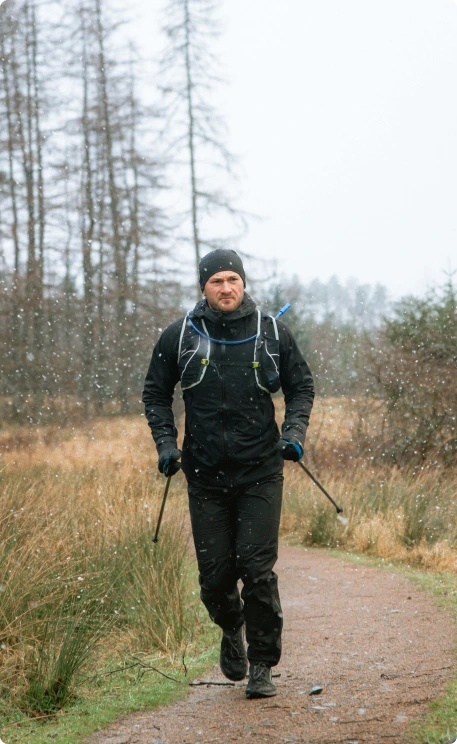
Running Tips for Heavier Runners: 4 Things I’ve Learned at 200+ lbs
Shout out to all my thicker runners. This one’s for you.
If you’re a bigger athlete, running can feel harder than it seems to be for everyone else. That’s not in your head. Most running advice is written for one body type, and it probably isn’t yours.
I’ve spent the best part of 10 years at 200-215 lbs (roughly 91-97 kg) and run thousands of kilometres in that time. Here’s what actually helps.
What do I mean by “heavier runner”?
I’m not only talking about people who are carrying extra body fat.
I’m also talking about people coming from a weightlifting or gym sport background, or anyone with a bigger frame. My YouTube friend Mark Lewis has spoken openly about how hard it was to get into running at 250 lbs (about 113 kg) and 6’6″ (198 cm). If that sounds like you, keep reading.
Can you be a heavier runner and still run well?
Yes. Absolutely.
From a young age we’re told there’s one runner’s body, and that’s what we should aim to look like. That’s fair enough if you’re chasing an Olympic final. For the rest of us, it just leaves us confused.
Some context on where I’m coming from at this body weight:
- Longest run: 100 miles in just over 22 hours 15 minutes
- 5K PB: 17:37
- Marathon: 3:17, and that was a training run, not a best effort
- Fastest mile: 4:58, on the same day as a 500 lb (about 227 kg) back squat
You don’t have to be genetically built for running to get out there and chase PBs of your own.
1. Build your running volume slowly
The biggest mistake I see is going too hard, too soon.
Running is a skill. It takes time to learn to move efficiently and to adapt to the fatigue that comes with it. Start steady, build your volume gradually, and don’t dive in head first.
That’s why having a plan matters. If you want structure, our OMNIA Coaching is built around exactly this.
2. Sort the practical stuff before it sorts you
For heavier runners, a few practical things come up more than anything else.
How to stop chafing when running
This is the most common one, so get ahead of it before it becomes a problem.
You’ll never catch me running without a liner in my shorts. That could be a 2-in-1 short like the Gymshark Speed 2-in-1, or a pair of undershorts under your normal ones. Whatever stops the chafing is worth it.
Next is chamois cream. It’s basically anti-friction cream, the same stuff Tour de France cyclists use, and it’s your best friend on long endurance sessions.
Choosing a trail running pack
If you’re heading out on longer runs and have a bigger upper body, some brands will fit you better than others.
The Osprey Duro 6 and 15 have suited me well. Some Salomon packs didn’t sit right around my back and shoulders. I’m not recommending one brand over another. Just shop around, because these packs are generally designed for conventionally built runners.
Hydration and nutrition for heavier runners
The generic advice online on how much to eat and how much sodium to take on during long runs probably isn’t specific to you.
You have more body weight to move, higher heat dissipation to deal with and more energy expenditure to fuel. So:
- Do a sweat test if you can (available through various organisations in the UK and the US).
- Experiment with your sodium, nutrition and hydration on long runs and big sessions.
- Take notes on how you respond, so you find what works for you rather than what works for a forum’s average.
3. Work on your running technique
The name of the game in running is efficiency. One small change can pay off hugely down the line.
If you come from a lifting background, you already know this. Moving weight through an inefficient movement pattern builds a motor pattern that won’t serve your long-term strength. Running is the same. Nail the technique first, then build from the ground up.
At an efficient stride length and cadence, you can run the same pace with a lower heart rate and lower oxygen consumption. That means a lower energy cost, and it helps protect you from injury.
What is overstriding, and why does it matter?
Overstriding is the biggest injury risk in running. It’s when your heel lands out in front of your body, with your knee extended and your leg straight ahead of you.
That position can increase your risk of patellofemoral pain, better known as runner’s knee, which is one of the most common running injuries.
What you want is an impact point directly below your hips and shoulders. My technique is far from perfect, but it’s much better than it was.
A simple way to spot overstriding
Try a pair of barefoot shoes (like Vivobarefoot) and go for some strides at a quick pace. If you’re overstriding, you’ll feel it straight away.
Conventional running shoes have cushioning that disguises the problem. Barefoot shoes make you far more aware of how you’re interacting with the ground.
4. Use Zone 2 training to build your base
Zone 2 is the heart rate zone that builds your aerobic capacity. That capacity underpins your ability to adapt to and tolerate training volume, which makes it the foundation of fitness.
It’s also your best defence against the classic mistake: heading out on your first run in years and trying to go sub-20 for 5K. Do that and you might join the many people who tore a calf in lockdown and paid for their physio’s holiday.
Build steadily. Start slow, accumulate volume, then add pace work like 5K efforts and 800m repeats on the track.
How do you know if you’re in Zone 2?
- Heart rate: Use a sports watch or a chest strap and set your zones.
- The talk test: If you can hold a conversation while you run, you’re probably working aerobically.
- Nasal breathing: If you’re only breathing through your nose, you’re effectively regulating your pace and staying aerobic.
Frequently asked questions
Can you run if you’re over 200 lbs?
Yes. Body type doesn’t decide whether you can run. Build volume gradually, get your gear right, work on your technique and use Zone 2 training to build a base.
How do I stop chafing when I run?
Wear shorts with a built-in liner or undershorts, and use anti-friction cream (chamois cream) on longer efforts.
What is the best way to avoid running injuries as a heavier runner?
Progress your volume gradually and pay attention to your technique. Overstriding is the biggest injury risk, and it’s linked to runner’s knee.
How do I know if I’m in Zone 2?
Use a heart rate monitor, the talk test (can you hold a conversation?) or nasal breathing.
The takeaway
Running as a heavier athlete isn’t about fitting a mould. It’s about building slowly, sorting the practical stuff, moving efficiently and building your aerobic base.
If you want a plan built around your body and your goals, that’s what we do at OMNIA. Check out our Coaching here.
 How To Fuel Your Triathlon (Sprint + Olympic)
 How to Warm Up as a Hybrid Athlete
 Should Your First Triathlon Be an Ironman?