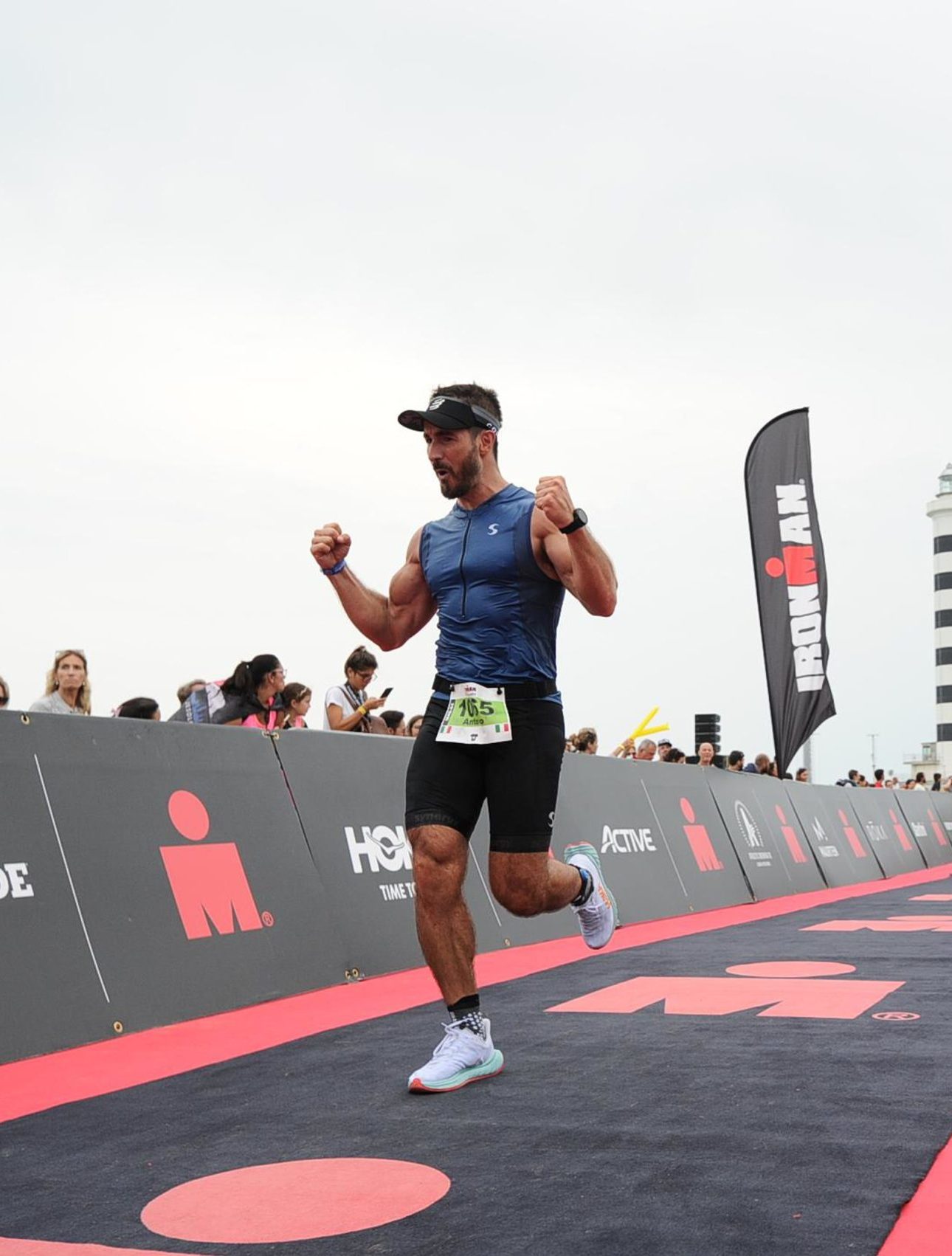
Should Your First Triathlon Be an Ironman?
Scroll social media for long enough and you’ll find them: the “my first triathlon was an Ironman” posts. Zero to 140.6 miles, no shorter races in between. It gets presented as the ultimate flex.
It isn’t. And if you’re actually training for one, it’s worth understanding why – because the reasons go a lot deeper than “you should build up gradually.” Here’s the honest, no-BS breakdown from our coaches on why an Ironman as your first triathlon is usually a mistake, what the real risks are, and the rare cases where it actually makes sense.
The Social Media Version vs. The Real Version
Here’s the part that rarely gets mentioned in the caption: almost nobody attempting an Ironman as their “first triathlon” is actually starting from zero. Scratch the surface and you’ll usually find a training Instagram, a running history, years of cycling, or a background in another endurance sport entirely.
What they haven’t trained for is the race itself. What they have trained for, extensively, is endurance. That’s a very different starting point to someone with genuinely little athletic background deciding their first ever multi-sport event will be 2.4 miles of swimming, 112 miles of cycling, and a marathon to finish.
And crucially – the version of the day you see online is rarely the whole story. The struggle, the near-DNF, the parts that weren’t enjoyable in the moment, tend not to make the highlight reel. What you’re seeing is survivorship bias with good lighting.
Why Skipping the Shorter Distances Costs You More Than You Think
You don’t learn if you actually like the sport
Triathlon is expensive to get into and even more expensive to fall out of love with. Go look at any secondhand marketplace and you’ll find no shortage of barely-used triathlon bikes captioned “bought for my Ironman, selling because I’m done.” People are spending serious money on a sport they haven’t given themselves the chance to actually enjoy yet.
Shorter races let you test that. Do you love the training process, the community, the suffering – or did you just love the idea of finishing one big race and being able to say you did it?
You skip the skills that only show up under race conditions
Basic bike maintenance. Fixing a puncture mid-race. Managing nutrition and hydration once you’re six, eight, ten hours into moving. These aren’t things you can fully learn in training — they’re things you learn by racing, making small mistakes in low-stakes events, and fixing them before it matters.
Skip straight to Ironman and your first puncture might be in the middle of a 112-mile bike leg you paid hundreds of pounds to start. One coach we spoke to described exactly that scenario ending someone’s race – a completely avoidable DNF, caused purely by inexperience rather than lack of fitness.
Nutrition is the single biggest risk – and there’s no shortcut to learning it
There is no universal fuelling formula. What works for one athlete doesn’t work for another, and even the details – which products, how many grams of carbohydrate per hour – take real trial and error to dial in. The only way to learn what your gut can handle at hour nine is to have been in a situation resembling hour nine before. Shorter races and long training sessions give you that. A first-ever Ironman does not.
You haven’t built the mental toolkit yet
Physical fitness gets most of the attention, but the mental side of endurance racing is a skill in its own right — and it’s built incrementally, not overnight.
Learning to break a race into manageable chunks. Learning to push through the moment your brain starts screaming to stop. Learning how to pace so you don’t blow up in the first half and crawl through the second. These are skills athletes build over years of shorter events, not something you can download the week before your first big race.
Without that toolkit, the point in an Ironman where things get hard – and they will – becomes far harder to push through than it needs to be.
The financial risk is real
Ironman entry fees alone are significant before you’ve bought a single piece of kit, a tyre, a nutrition product, or covered travel and accommodation. Mistakes in an event like this aren’t just physically costly – they’re expensive in a very literal sense. A mechanical issue, a nutrition failure, or a DNF caused by inexperience doesn’t just cost you the day. It costs you the entry fee, the kit, and everything you put into the build-up.
Build up through shorter, cheaper races first and you’re not gambling that entire investment on lessons you haven’t had the chance to learn yet.
“But I Know Someone Who Smashed Their First Ironman”
They exist. And the pattern behind them is consistent: a deep, often multi-year background in another endurance discipline – ultramarathons, competitive running, serious cycling volume – that built the aerobic base, durability, and mental resilience an Ironman demands, even without triathlon-specific racing experience.
If you’ve got a genuine training history like that, and you’re building toward an Ironman over a year or more with the volume to match, that’s a different conversation. The exception isn’t “no training required.” It’s “different training, still substantial.”
For almost everyone else – genuinely new to endurance sport, with no long-distance racing or training history behind them — the maths just doesn’t add up in your favour.
The Case for Taking It Slow
There’s a version of this that isn’t about being cautious for caution’s sake. It’s about getting more out of the whole process.
Progressing through shorter distances first means:
- You develop a real love for the sport, not just the idea of finishing one race
- You build the physical and mental skills that make race day dramatically more enjoyable
- You reduce the financial and physical risk of a single, high-stakes, high-cost event
- You give yourself more milestones to chase, rather than peaking too early and running out of goals to aim for
There’s a simple way to think about it: the race itself is only ever going to be somewhere around ten hours of your life. The training that gets you there — the months of early mornings, the discipline, the person you become along the way — is the actual achievement. Rushing straight to the finish line skips the part that was supposed to be the point.
The Bottom Line
If you’re new to endurance sport and considering an Ironman as your first triathlon, our honest advice is: don’t.
Not because you’re not capable of the distance eventually, but because you’re skipping the steps that make the day itself safer, more affordable, and genuinely more enjoyable.
Build through the shorter distances. Learn to fix a puncture before your bike leg depends on it. Dial in your nutrition somewhere it costs you a bad training session, not a DNF. Give yourself the time to actually fall in love with the sport before you commit to its hardest single day.
The Ironman will still be there. Give yourself the season – or two – to actually be ready for it.
Building toward your first triathlon, or your first Ironman, and want a structured plan that actually accounts for where you’re starting from? That’s exactly what OMNIA coaching is built for. Get in touch to find out more.
 How To Fuel Your Triathlon (Sprint + Olympic)
 How to Warm Up as a Hybrid Athlete
 The BEST Advice for Heavier Runners