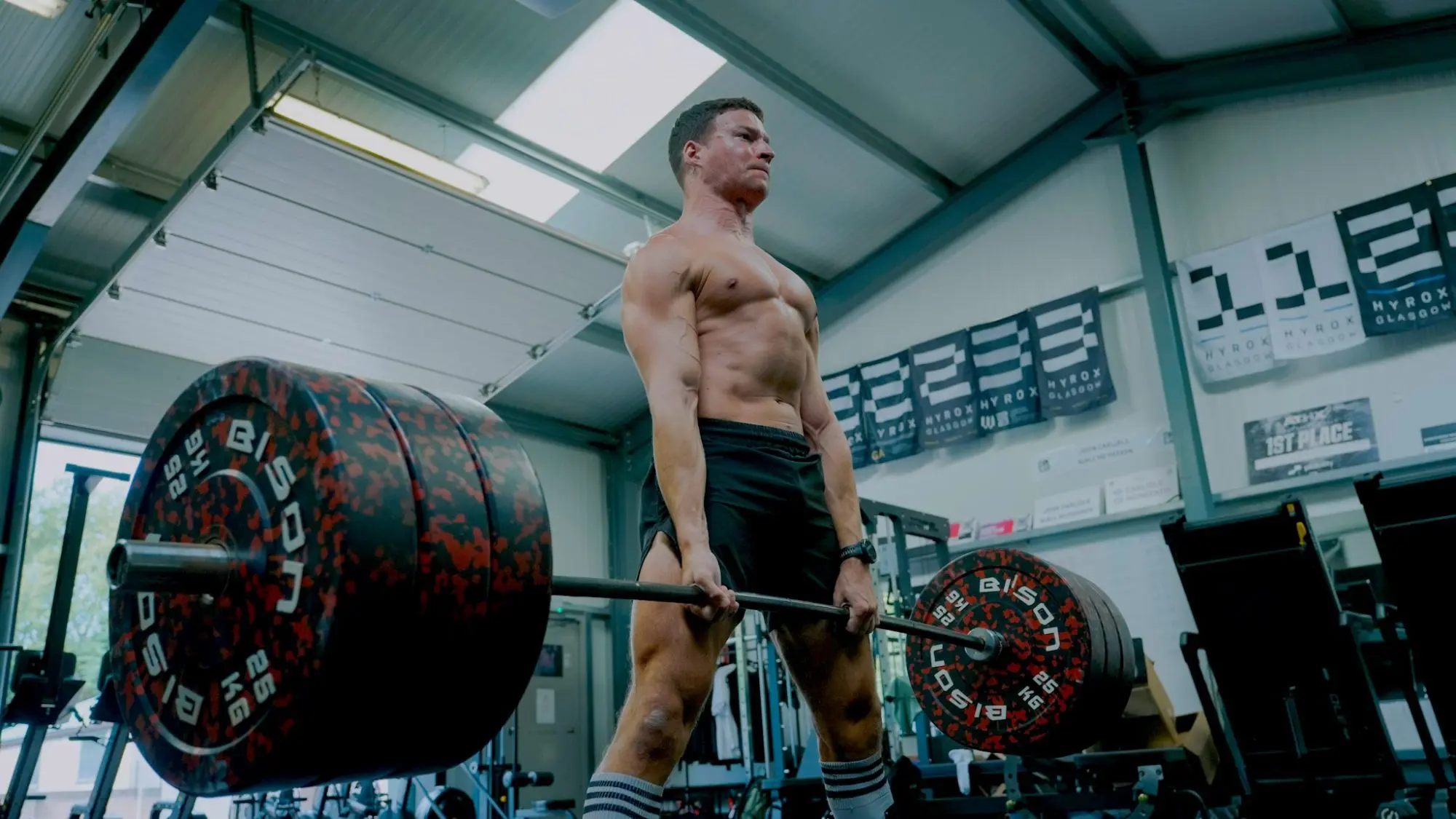
Hypertrophy Myths:
What’s Actually Worth Keeping (and What to Drop)
The internet has never had more to say about building muscle.
Which, weirdly, isn’t always a good thing.
The research has come a long way in the last decade. The conversations have got better too.
We’ve gone from Facebook groups, to Reddit threads, to (shameless plug incoming) the discussions happening every day in the OMNIA community. People are less wedded to dogma than they used to be.
But plenty of outdated ideas are still knocking about, quietly costing people progress.
Here’s what’s worth keeping, what’s worth binning, and what sits somewhere in between.
Key takeaways
- Keep: training within 1 to 3 reps of failure, progressive overload, smart exercise selection, and full range of motion.
- Drop: training by feel, obsessing over rep ranges, constantly rotating exercises, and treating fatigue as proof of a good session.
- Nuanced: bench press isn’t automatically the best chest builder, and lengthened-position training is a useful tiebreaker, not a religion.
- The real mistake: paying more attention to how a session felt than to whether your output actually improved over time.
What still matters for building muscle?
How close to failure should you train to build muscle?
Most of your sets should finish within 1 to 3 reps of failure.
This is the single most common thing people get wrong. And it’s rarely laziness. It’s that effort is genuinely hard to judge.
Your triceps ache, you’re breathing hard, your shoulder feels a bit off. Your brain logs all that as “effort”, but that doesn’t mean the target muscle was actually challenged.
That doesn’t mean grinding every set into the dirt. Do that and the fatigue will cost you later in the session. It just means stop leaving 6 or 7 reps in the tank as a habit.
Knowing where you are relative to failure is a skill. It comes mostly from practice, and occasionally from testing it on purpose, so you know what a genuine RPE 9 or 10 actually feels like.
What is progressive overload, really?
A heavier weight doesn’t cause muscle growth. It’s evidence that growth has already happened.
Most people have this backwards.
Your muscle adapts to the stress you applied and recovered from. The bigger number on the bar is just you catching up to where your body already is.
Chase the number too hard and you end up grinding ugly reps, or missing lifts, just to hit a target that progressive overload “says” you should be hitting.
Ask a better question each session: has my capacity actually increased?
Sometimes that’s more weight. Sometimes it’s the same weight with two more reps in reserve. Progress doesn’t have to be linear to be real.
What’s the best exercise for building muscle?
Wrong question. The best exercise is one you can load properly, perform consistently, and progress over time.
What builds muscle is repeatable, high-effort work that you push forward. The exercise is just the delivery mechanism.
Better questions to ask:
- Does it let me load the target muscle properly?
- Can I perform it with consistent, good technique?
- Can I keep doing it without breaking down?
If a movement irritates a joint, or you can never nail the same technique twice, it doesn’t matter where it ranks on someone’s list. It isn’t doing its job for you.
Does full range of motion build more muscle?
Usually, yes. Training through a longer range tends to drive more hypertrophy, as long as your technique holds up.
A longer range recruits more muscle tissue and puts more tension on it at end-range.
That doesn’t mean turning every rep into a max-stretch competition. It means if you’re regularly cutting reps short because the load is too heavy or you’re rushing, you’re leaving gains on the table.
Squat to depth. Let the bar touch your chest on bench. Get the stretch on a lat pulldown. It matters.
Which hypertrophy habits should you drop?
Should you train by feel?
No. Track your output, not how a session felt.
This is probably undermining more people’s progress than anything else, and nobody talks about it.
“Did I feel it in the muscle?” is subjective. It changes day to day with your sleep and stress. And it’s very easy to convince yourself a new variation is better just because it’s new.
What actually tells you training is working:
- Are you doing more reps with the same weight than a month ago?
- Are you adding load over time?
Chase the pump instead of tracking output and you end up cycling through variations every few weeks, never knowing whether you’re getting stronger at anything.
Is there a “best” rep range for hypertrophy?
Not really. Effort and volume matter far more than the number of reps.
You’ve heard it a thousand times: 1 to 5 for strength, 8 to 15 for hypertrophy, 15 to 30 for endurance.
It’s largely wrong. Or at least, far less important than people make out.
- A set of 5 close to failure builds muscle.
- A set of 30 close to failure builds muscle.
- A set of 12 with six reps left in the tank builds very little, however perfectly it sits in the “hypertrophy range”.
The real questions are: are you doing enough total volume, and are you giving the muscle a reason to grow? Roughly 6 to 20 reps works for most lifts. Use common sense for the rest.
Should you change exercises to “keep the muscle guessing”?
No. Stick with your main lifts long enough to track real progress.
When you start a new exercise, a big chunk of your early progress comes from motor learning. You’re getting more coordinated, not necessarily more muscular. It feels like progress, but it’s not the same thing as growing tissue.
Pick your bread-and-butter lifts (squat, deadlift, bench, overhead press, pull-up variations) and keep progressing them. If you want variety, rotate your accessories every 6 to 8 weeks.
Does feeling wrecked mean the session worked?
No. Fatigue isn’t proof of a productive session.
You can be absolutely destroyed by a session that barely stimulated growth. And you can feel totally fine after one that drove real adaptation.
What matters is whether you trained the target muscle close enough to failure, with enough volume, in a way you can recover from and repeat.
Managing fatigue so your later sets, and later sessions in the week, are still worth doing is one of the most underrated skills in training. Full stop.
This matters even more for hybrid athletes. Every bit of junk fatigue from the gym is fatigue you’re carrying into your run or ride.
Does exercise order matter?
Yes. Order your session with intent, not habit.
“Big compounds first, accessories after” is fine in principle. But think about which lifts pile on the most systemic fatigue, and whether that’s compromising what comes next.
If a lift is particularly taxing for you, physically or mentally, everything after it pays the price.
What’s the nuanced middle ground?
Is bench press the best exercise for chest growth?
Not automatically. It’s a great lift, but it isn’t the best chest builder for everyone.
Bench is a multi-joint movement. Tricep and front-delt fatigue, plus shoulder blade position, can mean your chest gets less of the stimulus than you’d assume. For some people, a dumbbell or cable variation does the job better.
That’s not a reason to drop the bench. It’s a reason to think about what you actually want from it.
Is lengthened-position training worth it?
It’s worth factoring in, but don’t overthink it.
The research behind it is genuinely interesting, and it’s changed how a lot of coaches pick exercises. It’s also become something people over-engineer on Instagram.
Use it as a tiebreaker between two similar exercises. Not as a reason to reject everything that doesn’t hit peak stretch.
The bottom line
Train hard enough, and close enough to failure. Do enough volume. Make sure it’s recoverable. Push it forward over time.
That’s it. Those principles aren’t going anywhere.
What can go: the rep-range obsession, constant exercise rotation, chasing the pump, and the idea that “hard” automatically means “productive”.
Underneath almost all of it is the same mistake: caring more about how a session felt than whether it produced more output over time.
The athletes who make consistent progress aren’t hunting for a secret protocol. They’ve nailed a handful of principles, applied them consistently, stayed patient, and adjusted when something genuinely wasn’t working.
Muscle takes a long time to build. There’s no way round that bit.
Want this built into your training, not just something you nod along to?
That’s exactly what our coaching team does with athletes 1:1. A programme built around your lifts, your recovery and what’s actually working for you, adjusted as we go.
Want to learn more about hybrid training? Download our free hybrid training guide here
 How to Run a Sub-5 Minute Mile
 How to Brace for Your Lifts
 How To Nail Your Ironman Nutrition