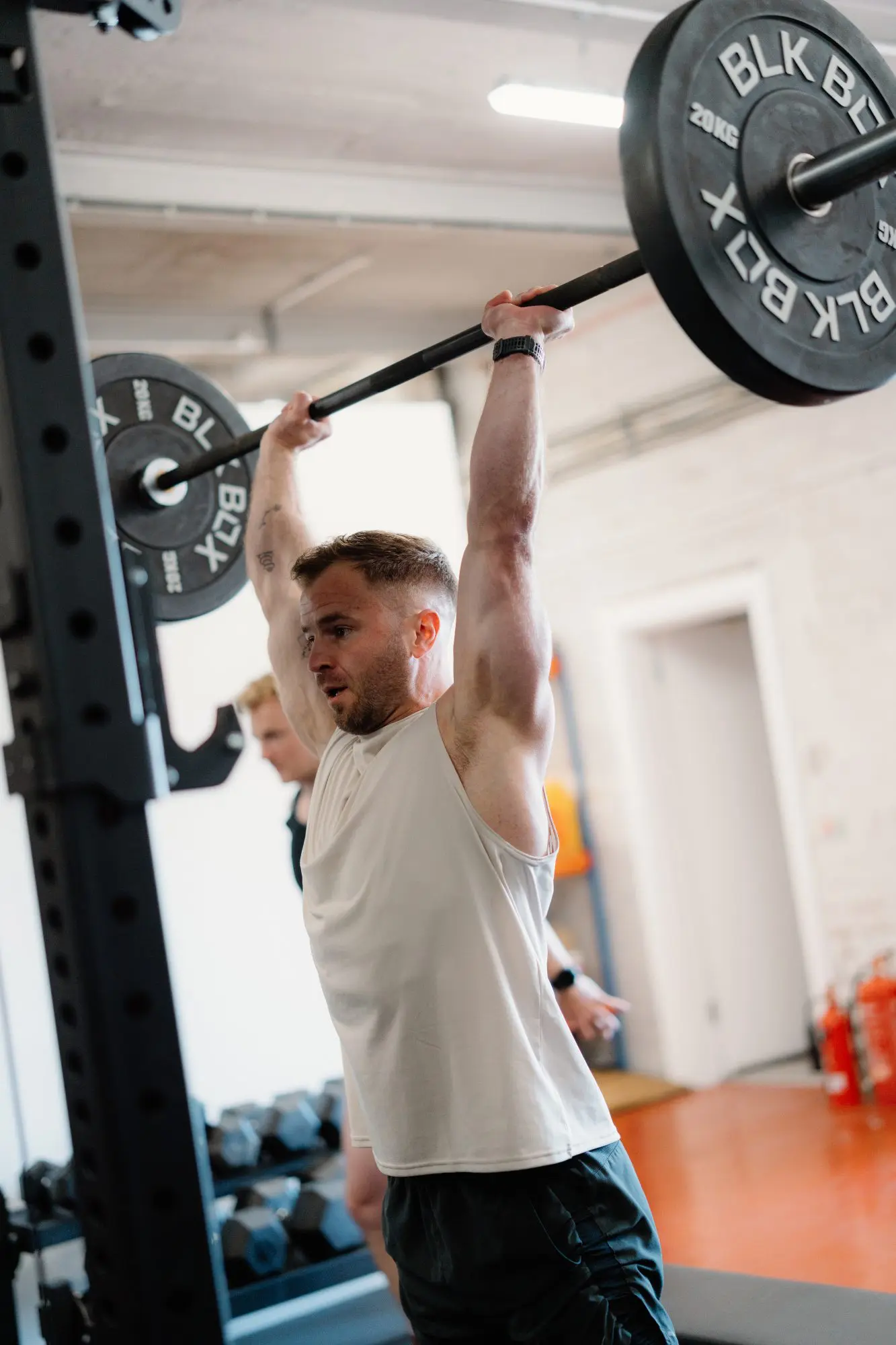
How to Brace for Your Lifts
(And the Two Mistakes Almost Everyone Makes)
By Kieran Richardson, Coach at OMNIA
If there’s one skill that’ll make you feel stronger in the gym almost instantly, it’s learning how to brace properly.
It’s also the thing myself and the coaching team find ourselves correcting more than anything else when beginners first join us. So in this post we’re covering what bracing actually is, the two mistakes we see all the time, and how to get it right on your squat and deadlift.
The short version
- Bracing is using your breath and your core muscles together to tighten your midsection, so force transfers efficiently into the bar.
- Most people get it wrong in one of two ways: they either tense their abs with no big breath, or they breathe up into their chest and flare their ribs.
- Bring your rib cage down first, then breathe low into your core rather than up into your chest.
- Take your biggest brace before you un-rack the bar (or at the top of a deadlift), then top it up and re-brace between reps.
What is bracing in the gym?
Bracing is using your breath and your core muscles together to tighten your core, so force can transfer efficiently from your lower body into the bar. It’s most obvious on squats and deadlifts, but it works for upper body lifts too.
An effective brace has two parts: a big breath drawn into the right place, and your core muscles doing their job properly. Get either of those wrong and you’ll lose efficiency and strength.
What are the most common bracing mistakes?
The two mistakes we see all the time are simply tensing the abs without taking a proper breath, or taking a big breath into your chest instead of your core.
Mistake 1: Why isn’t tensing your abs enough?
Plenty of people know they should “use their core”, but nobody has ever told them about the breath. So they tense their abs and leave it there, which means they’re not making full use of the air they could be drawing down to create what is called intra-abdominal pressure and stabilise themselves.
Mistake 2: Why is breathing into your chest a problem?
Other people know they should take a deep breath, but not where it should go. So they suck a big breath into their chest and flare their rib cage, which leaves them without a stable platform to transfer force through.
What we’re after is a combination of the two: core tight, breath low and ribs down.
How do you brace properly?
You brace properly by bringing your rib cage down, breathing low into your core, and checking you can feel that breath at the front, sides and back of your midsection.
Step 1: Bring your rib cage down
Stand side-on to a mirror and have a look at your rib cage. You don’t want it flared up, you want it brought down nice and flat.
I like to picture the rib cage/core area and your pelvis as two boxes. If you flare your ribs, you’re tilting one of those boxes, whereas if you wanted to stack boxes in the strongest, most efficient way, you’d stack them flat on top of each other. In the same way, bringing the ribs down gives you a solid platform to work from.
Step 2: Breathe down into your core
From there, bring your breath down into your core rather than up into your chest.
Step 3: Check it with the hand test
An easy way to check you’re doing it right is to put one hand on your tummy and one on your chest.
As you take a deep breath, the hand on your tummy should move while the hand on your chest stays put. If your chest hasn’t moved and you can feel the breath in your lower abdomen, you’re on the right track.
Step 4: Feel it in three places
Now check you can feel it in three spots:
- Front: your stomach moves as you take the breath.
- Sides: you feel the breath and the tightening in your sides as you bring your core muscles down.
- Lower back: you feel the breath coming down into your lower back as well.
If you’re getting all three at the same time with your rib cage kept down, you’ve very likely got a nice strong brace.
How do you brace in the squat?
To brace in the squat, take a deep bracing breath before you un-rack the bar, keep your ribs down, and top up your brace before you start squatting if the load is heavy.
Taking that breath before you un-rack matters even more as the weight goes up, because that pressure is what helps you get the bar out of the rack in the first place. With a heavy load, re-brace again before you start the squat, and think of it as topping up the air.
The most important thing to watch is what happens as you go down. Your rib cage shouldn’t flare and your core should stay tight the whole way. That breath acts like a built-in weightlifting belt you can brace against, keeping you strong and stable through the rep.
How do you brace in the deadlift?
You brace in the deadlift exactly the same way as in the squat. It just looks a bit different because the weight starts on the floor.
Bring your rib cage down, breathe deep into your core rather than your chest, and keep your ribs down and engaged as you pull.
The same principle applies to every barbell lift. It looks slightly different from one lift to the next, but the goal is always the same, which is to transfer force properly.
When should you take your brace?
Take the biggest part of your brace at the point in the lift where you’re still free to breathe.
- Squat: before you un-rack the bar, so you’re not trying to breathe with all that weight crushing down on you. Take a deeper, more stable brace there, then top it up.
- Deadlift: at the top, or before you get too tight in the bottom position.
Should you re-brace between reps?
Yes, especially on squats and deadlifts.
Do a rep, take a breath, give yourself that moment, then go again. With deadlifts you don’t even need to keep hold of the bar the whole time, so take your bracing breath, reset, and go again between each rep.
Frequently asked questions
What does bracing mean in lifting?
Bracing means using your breath and your core muscles together to tighten your core, so force transfers efficiently from your body into the bar.
How do you brace your core properly?
Bring your rib cage down flat, then take a big breath low into your core rather than up into your chest. You should feel it at the front, the sides and your lower back at the same time.
Should you breathe into your chest or your stomach when bracing?
Breathe into your core, not your chest. Breathing up into your chest flares your rib cage and takes away the stable platform you need to transfer force.
Is bracing just tensing your abs?
No. Tensing your abs without taking a big breath means you’re not making full use of the air you can draw down, so you need both the breath and the core muscles working together.
How do I know if I’m bracing correctly?
Put one hand on your tummy and one on your chest. As you breathe in, the hand on your tummy should move and the hand on your chest shouldn’t.
When should I brace in a squat?
Brace before you un-rack the bar by taking a deep bracing breath there, then top it up before you squat if the load is heavy.
Do I need to re-brace between reps?
Yes. Take a bracing breath between every rep on lifts like the squat and deadlift, then go again.
The bottom line
Bracing is one of those things that feels simple right up until there’s a heavy bar on your back. Bring your ribs down, breathe low into your core, take your big brace while you’re still free to breathe, and top it up between reps.
Want help getting your lifts dialled in?
Getting your bracing nailed down alongside the rest of your technique, your training and your goals is where a coach makes the biggest difference.
Apply for OMNIA 1:1 coaching
Want to learn more about hybrid training? Grab our free Hybrid Training Guide.
 How to Run a Sub-5 Minute Mile
 How To Nail Your Ironman Nutrition
 The Metrics That Actually Matter