
How to Warm Up as a Hybrid Athlete
(Without Wasting Half Your Session)
Here’s an unpopular opinion: most people spend way too long warming up and nowhere near enough time actually training.
If you’re fitting serious training around work, family and the rest of life, every minute counts. Spend 30 minutes warming up in a 90-minute session and you’ve given away a third of your training time, which is a lot of gains left on the gym floor.
So in this post, myself and the coaching team are breaking down what a warm-up actually needs to do, how to build one for lifting, running, cycling and swimming, and how to keep it short so you can get on with the good stuff.
The short version
- The job of a warm-up is to let you safely apply load or effort. That’s it.
- A good warm-up does three things: it raises your heart rate and muscle temperature, rehearses the movement, and switches you on mentally.
- RAMP is a useful framework, not a rulebook. Go from low to high intensity, simple to complex, and less focus to more focus.
- For most strength sessions, the training is the warm-up.
- The faster and more complex the movement, the more prep it needs.
- Once you’re on the bike or in the pool, stay there.
What is a warm-up actually for?
A warm-up exists to let you safely apply load or effort, nothing more and nothing less.
A good one does three things:
- Raises your heart rate and muscle temperature, which helps you produce more force later in the session
- Rehearses the movement you’re about to do
- Gets you mentally switched on
Somewhere along the way, though, warm-ups turned into box-ticking. Long floor-based mobility routines do numbers on social media (the irony of me saying this as someone who posts training content daily hasn’t escaped me), but they’re often non-specific and slow. And if you’re not breathing any harder, are you even warm?
My guess is that a lot of the mobility obsession comes from the Olympic weightlifting side of functional fitness. Most people simply don’t need that much mobility work to prepare for basic movement patterns like squatting, pressing or running.
If you love a long routine and you’ve got the time, crack on, because it won’t do you any harm. But if time is tight, spend as little of it as you can warming up and put the rest into getting the training done.
What is the RAMP warm-up?
RAMP is a four-phase warm-up framework (Raise, Activate, Mobilise, Potentiate) that you’ve almost certainly seen before:
- Raise: lift your heart rate and muscle temperature
- Activate: switch on the muscles you’re about to use
- Mobilise: work through the positions the movement needs
- Potentiate: build intensity step by step towards your working sets
It’s a solid template, but the science doesn’t say you have to do it this way. In practice, the phases blur into each other. Take “activate”, for example, which happens naturally when you do a lighter version of the lift because the muscles are already doing the work. No band walks required.
What actually matters is that your warm-up moves along three sliding scales:
- Low intensity to high intensity
- Simple to complex
- Less focus to more focus, so your head is in the game by the time the real work starts
Nail those three and the exact format is up to you.
How do you warm up for strength training?
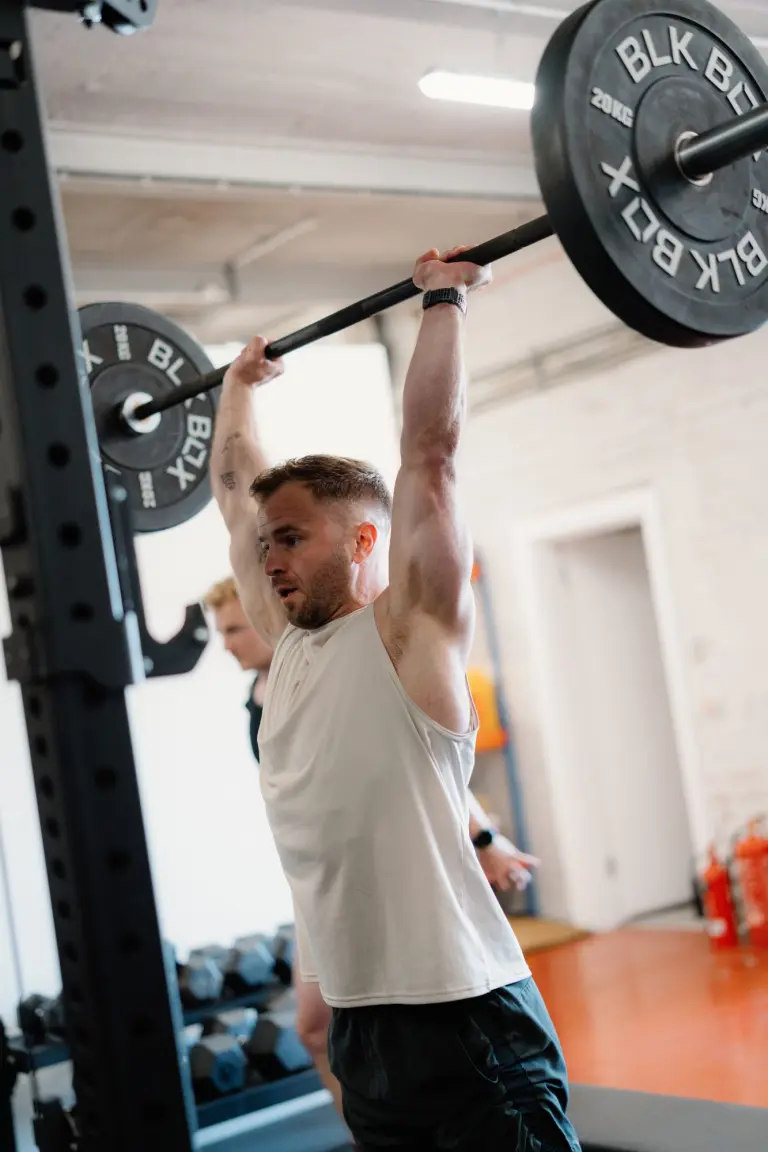
For most lifting sessions, the training itself is the warm-up. Here’s how we structure it with our athletes.
Step 1: Raise
Spend a few minutes moving easily to get your heart rate and muscle temperature up, and remember that even the walk to the gym counts for something.
Step 2: Mobilise what you need (and only what you need)
Pick the positions the lift actually demands. Before squats and deadlifts that’s usually hips and hamstrings, while before pressing it’s a bit of low-level shoulder work.
Step 3: Do the movement
Start with the empty bar or a light load for higher reps.
Step 4: Add weight gradually
Drop the reps as the weight goes up until you hit your working sets. An easy way to do it is by plates (one plate, two plates, three plates, then your top set), and the progressive loading takes care of the potentiation for you.
Done well, this gets you ready for a heavy top set in under 10-20 minutes depending on how heavy you’re going.
Strength warm-up tips from the coaching team
- Don’t make warm-up sets too easy. They should feel like work, so you get the physiological effects you’re after.
- Don’t wreck yourself either. Nothing in the warm-up should drain you before the main event. Remember, the idea is to activate, not fatigue.
- Use between-set drills if a position really needs help, like a drill that improves your squat depth.
- Complexity changes the rules. The more technical the lift, like the snatch or clean and jerk, the more warm-up time it needs, although most basic gym lifts aren’t complex.
- Awkward objects need more prep. For example, strongman implements are harder to load gradually, so start with lighter versions first.
How do you warm up before running?
The principle is the same as lifting: start easy, build gradually, let your breathing settle, then build again.
Here’s what that looks like before a track session of 6 x 400m:
- A 2km warm-up jog, starting very easy and progressing slightly, with a couple of quicker efforts thrown in
- A short rest
- A few 50 to 100m strides
- Leg swings and some dynamic mobility
This lifts your heart rate, introduces towards the pace you’re about to run, and gives your breathing a chance to calm down before rep one.
Why does a gradual build-up work?
When you start exercising, you go into oxygen debt and your breathing has to play catch-up, which is the last thing you want happening on your first working rep. A short, steady spell of running lets your ventilation catch up and settles you into a steadier state, so you’re ready when the rep starts.
Do faster sessions need a longer warm-up?
Yes. Running 400m reps at around five-minute mile pace needs less prep than flat-out sprinting in spikes, because the faster you go, the harder your muscles have to switch on. That’s exactly why hamstring injuries are so common in sprinting.
Think of it as a dimmer switch rather than an on/off switch. If you’re sprinting at a modest pace you’ll get away with less, but if you’re getting close to top-end speed you won’t.
Do you need a 10 to 15 minute floor routine before a run?
Usually not. Unless a physio has given you specific exercises for a specific issue, you’re better off spending that time moving on your feet, because staying upright and moving keeps your heart rate slightly elevated and protects all the good work from your raise phase.
That said, if you’ve got personal favourites like leg swings or A and B skips, keep them. The mental benefit of a routine you trust can easily outweigh a few extra minutes.
How should you warm up for a race or time trial?
Short, fast races need more warm-up, not less.
Runners racing the mile found that extending their warm-up from around 1,200m to 3 to 4km, then taking five to ten minutes to settle before the gun, improved their performance. The longer build meant their heart rate had already peaked, so there was no big spike in effort at the start and they could get straight into race pace.
How do you warm up for cycling?
The principles are identical:
- Start easy
- Gradually increase the effort
- Let your heart rate rise, then settle
- Move into your main work
Cycling is more concentric than running, with no heavy landings or push-offs, so you’re at lower risk of the issues you’re warming up to prevent in running.
The practical rule is to stay on the bike, because hopping off for activation work just breaks your flow. If you’ve got position-specific mobility to do, get it done before you clip in.
How do you warm up for swimming and skill-based sessions?
Skill-focused sessions follow the same structure, with extra attention on technique and focus. A well-learned skill should feel effortless, and your warm-up should help you get there.
Here’s a swimming example:
- Land-based mobility for shoulders, lower back and hip flexors
- Ease into the first part of the warm-up, feeling your way through the water
- Gradually shift from feel to effort so your pace rises naturally
- Use paddles or a pull buoy to prep for the main set
The same rule applies as on the bike: once you’re in the pool, stay in the pool.
Should skill work come first?
If you’re still learning a skill and the drills won’t wipe you out, build them into the warm-up.
Say you’re swimming three 2.5km sessions a week. You could spend the first 1,000m on drills and technique, then do 1,500m of higher-quality work to put it into practice, and in our experience this lifts the quality of all three sessions.
This only applies while you’re learning, though. Once a skill is nailed down, practising it under fatigue becomes useful, because that’s exactly what you’ll face late in a race.
Frequently asked questions
How long should a warm-up be?
It depends on the session. Most strength sessions need 10 to 20 minutes including warm-up sets, while fast running sessions and races benefit from longer, more specific warm-ups.
What is the purpose of a warm-up?
A warm-up lets you safely apply load or effort. It raises your heart rate and muscle temperature, rehearses the movement you’re about to do, and gets you mentally ready.
Do I need to stretch before training?
Not necessarily. Only mobilise what you need to reach the positions your session requires, because long, general stretching routines aren’t essential for most strength or endurance training.
Is RAMP the best warm-up protocol?
RAMP (Raise, Activate, Mobilise, Potentiate) is a useful framework, but it isn’t the only option. What matters most is progressing from low to high intensity, simple to complex, and less focus to more focus.
Should hybrid athletes warm up differently?
Hybrid athletes use the same warm-up principles but tailor them to each session. A heavy lower-body day needs hip and hamstring prep, while a track session needs strides and pace-specific build-ups.
Can I skip the warm-up if I’m short on time?
Not entirely, but if your session builds up gradually, like progressive warm-up sets in the gym, the early part of the training can double as your warm-up.
Do I need a longer warm-up for sprinting?
Yes. The closer you get to top-end speed, the more forcefully your muscles have to switch on, so you need a more gradual, thorough build-up to reduce injury risk, especially to the hamstrings.
Should I warm up off the bike or out of the pool?
Do any position-specific mobility first, then stay on the bike or in the water. Getting off to do activation work breaks your flow and lets your heart rate drop.
The bottom line
Shorten your warm-up and put that time into training. Start easy, build progressively, match the demands of the session, and then get on with it, remembering that the faster and more complex the movement, the more prep it needs.
Want help structuring your hybrid training?
If you’re juggling strength, running, cycling or swimming and you want a plan built around your goals and your life, that’s exactly what we do at OMNIA.
Expert insight from coaches who live and breathe hybrid training and who’ve done the kind of things you’re training for.
Find out more about 1:1 coaching with OMNIA
Not ready for coaching yet? No stress. Grab our free Hybrid Training Guide and start getting your training sorted today.
 How to Run a Sub-5 Minute Mile
 How to Brace for Your Lifts
 How To Nail Your Ironman Nutrition