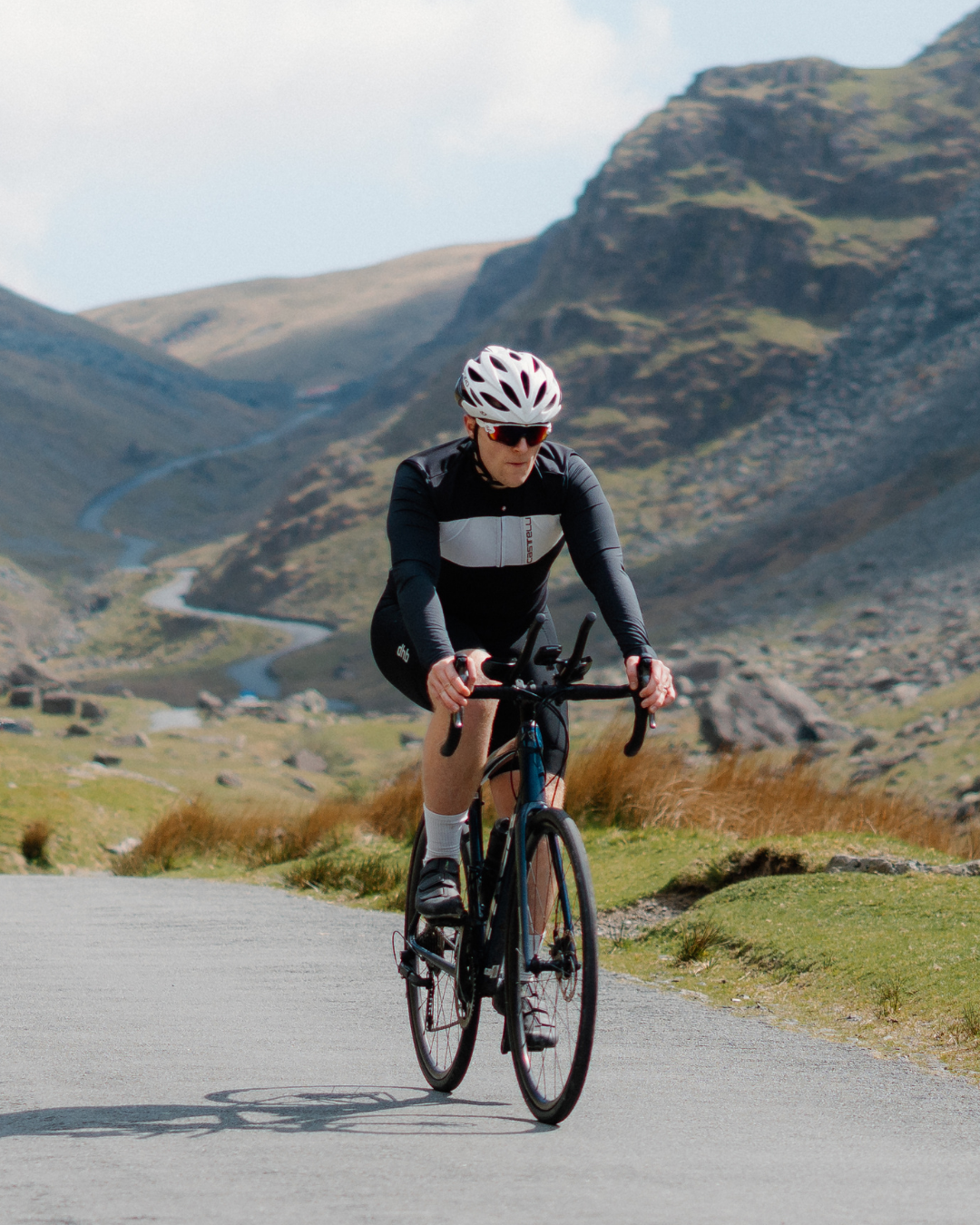
How to Improve Your Cycling
By Kieran Richardson
Let’s talk FTP.
Functional Threshold Power. Ramp tests. Zwift, TrainingPeaks Virtual, Sufferfest, MyWhoosh, Rouvy – there’s no shortage of platforms telling you exactly how many watts you can hold for an hour.
And everyone’s obsessed with the number.
So here’s the question we get asked more than almost anything else: How do I improve my FTP?
Our answer is usually another question: why?
Not to be difficult. But FTP is your theoretical one-hour max on the bike. Unless you’re specifically racing a one-hour time trial, that number barely applies to anything you’re actually training for. If you’re prepping for a 70.3, an Ironman, or just riding further and faster – optimising for FTP isn’t optimising for your race.
Why we’re all obsessed with it anyway
Let’s be honest about what’s really going on. It’s ego. It’s nice to hit a number and feel warm and fuzzy about it. It’s the cycling equivalent of your 5K time – the second you get power on your bike, you start comparing yourself to whatever wattage the pros are throwing down, and suddenly there’s a number to chase.
Nothing wrong with that. But don’t confuse a vanity metric with a training goal.
So what’s FTP actually for?
It’s a testing metric. That’s it.
We use it at the start of a training block to set your zones – a way of establishing where you are now versus where you’re trying to get to. From there, most of your training time is spent in zones that don’t directly move the needle on your one-hour max power at all. Your FTP will probably still go up as a byproduct. Sometimes it won’t. Neither outcome means the training’s not working.
Think of it like scale weight when you’re trying to change your body composition. The number gives you some context, but you’re not optimising for it – you’re optimising for less fat and more muscle, and the scale just tags along for the ride. Same with FTP. If your long ride goes from 90 minutes to 4 hours and you feel better at the end of it than you used to at 90 minutes, that’s the win – even if the FTP number sat still for 12 weeks.
What you should actually be training for
If FTP isn’t the target, what is? Depends what you’re training for, but a few things come up again and again:
Durability. The ability to still be functioning after 3, 4, 6 hours in the saddle – not just producing peak power for a short effort. This is the biggest differentiator for anyone doing 70.3 or full-distance triathlon, where you’re on the bike far longer than a recreational rider or crit racer ever will be.
Bike handling and racecraft. For a lot of newer or hybrid athletes, raw power was never the limiter. It’s cornering, reading the road, riding confidently in a group – skills a turbo session will never teach you, no matter how many intervals you stack.
Efficiency, not just fitness. Especially over full-distance triathlon. It’s less about pure aerobic ceiling and more about learning to ride the course – easing off before a rise so you can freewheel over the top, holding a sensible cadence, not just locking into one power number and grinding through everything regardless of terrain. Small margins, but over 180km they add up.
Aerobic vs muscular limiters. If your FTP test comes back lower than you’d like, the fix isn’t always “do more FTP work.” Work out what’s actually holding you back – aerobic capacity or muscular endurance – and train that specifically. Strength-background athletes in particular often have power sitting there dormant; they just haven’t conditioned their bodies to express it yet on the bike.
The unglamorous truth: time in the saddle
If there’s one thing that moves the needle more than anything else, it’s simply time on the bike. Consistent, unremarkable, zone 2 volume. Not exciting. Not a huge session that leaves you wrecked. Just showing up, week after week.
Cycling doesn’t reward the same “less volume, more intensity” approach that can work in running. The energy cost of an hour easy run is roughly equivalent to about three hours on the bike. Inconvenient, sure. But if you love riding, this is genuinely good news – the biggest gains often come from the sessions that feel the least hard.
Ride outside
If you can only do one thing to get better on the bike, ride outdoors.
Fitness built on a turbo will mostly transfer. But bike handling, position, wind, drafting, cornering, reacting to traffic — none of that comes from being locked into one static position in your living room. Athletes who do entire Ironman preps indoors are setting themselves up for a genuinely rude awakening coming out of T1 in race position for the first time.
That said, the turbo isn’t pointless – it’s actually one of the best tools for spotting position issues, precisely because there’s nowhere to hide. No side-to-side movement, no standing up to relieve pressure. If something’s off with your setup, you’ll feel it on the trainer in hour two instead of hour five outdoors.
Use both. But if the weather’s nice and your mates are heading out for a ride instead of your scheduled turbo session – unless you’re chasing a sub-5-hour Ironman bike split – go ride with your mates. Ninety minutes outside, surging on a hill, sitting behind a bus and learning to draft, will often do more for you than another structured indoor session ever could.
The bottom line
Test your FTP. Use it to set your zones. Then forget about it.
Train the things that actually carry you through race day – durability, bike handling, efficiency, and consistent time in the saddle. Your FTP will very likely improve anyway. But it was never the goal. It’s just the receipt.
Want a training plan built around what actually matters for your goals — not a random watts-per-kilo target? Find out more about our Coaching
 How To Fuel Your Triathlon (Sprint + Olympic)
 How to Warm Up as a Hybrid Athlete
 The BEST Advice for Heavier Runners