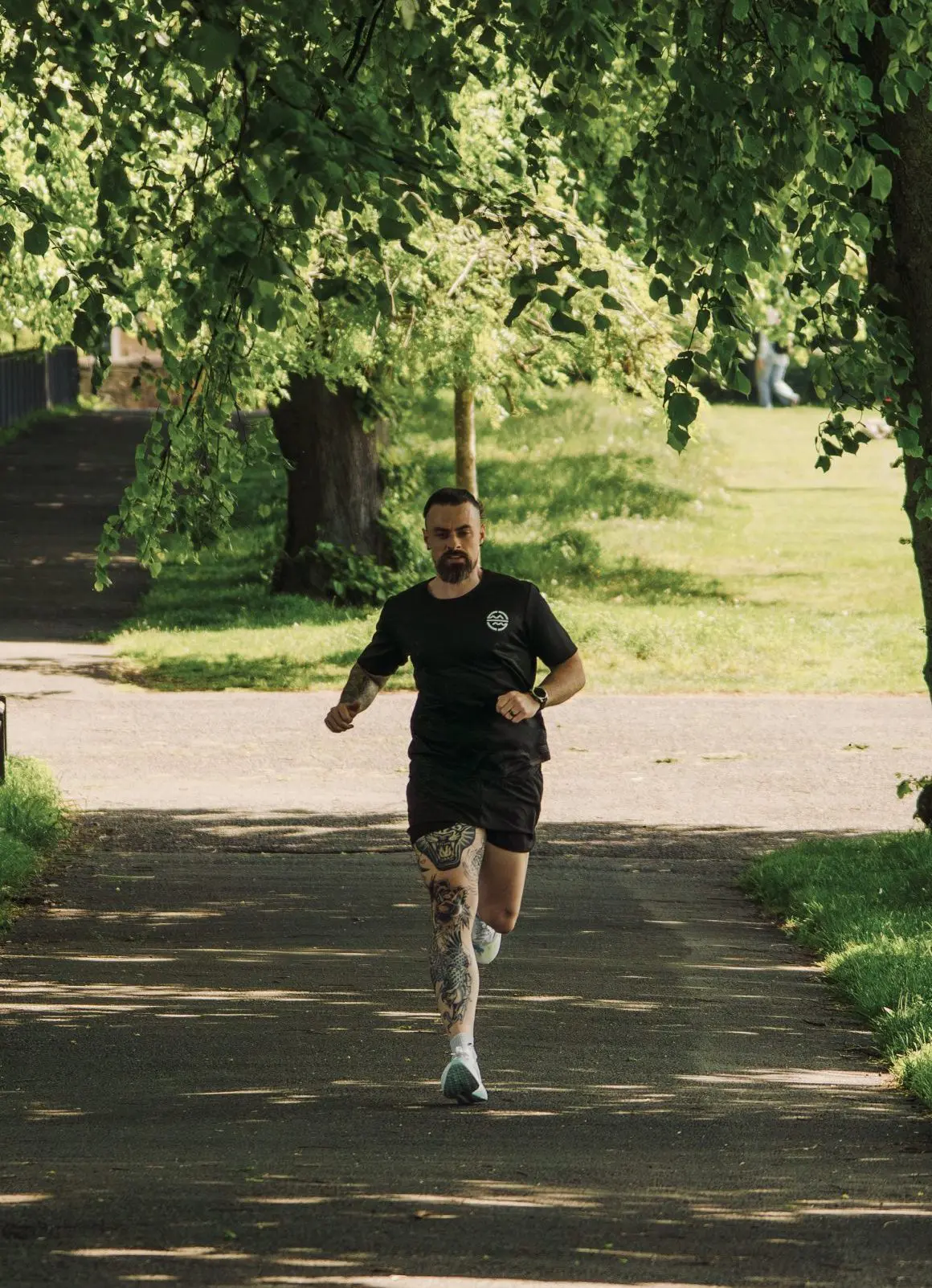
The TRUTH About Recovery
By James Blanchard and Tom McClure
Nobody wants to hear this. But the biggest recovery mistake most athletes make isn’t skipping the ice bath or forgetting their magnesium.
It’s training in a way that makes recovery a crisis in the first place.
If you’re constantly chasing soreness with anti-inflammatories and contrast therapy and £300 compression boots — you’ve closed the stable door after the horse has bolted. The dose was wrong. And no amount of gadgetry fixes a misdosed training week.
That’s where we want to start this conversation. Because recovery isn’t something you bolt on at the end of a hard block. It’s built into how you train, how you eat, and how you sleep. And if those things aren’t in order, the one weird trick the supplement industry is pushing this month isn’t going to scratch the surface.
Fill the Jar With the Big Rocks First
Think of it like this. You’ve got a jar. You want to fill it. You start with the big rocks — the things that take up the most space and matter the most. Then you fill the gaps with smaller rocks, then sand. If you start with the sand, you’ll run out of room before the important stuff even gets in.
Most athletes are starting with the sand.
They’re buying sleep trackers and Normatec boots before they’ve sorted their protein intake. They’re researching tart cherry concentrate while going to bed at midnight with their phone in hand. That’s not optimising recovery — that’s rearranging deck chairs.
The big rocks are simple. Unsexy. Not going to get any clicks on social media. But this is what actually moves the needle:
Sleep Is the Non-Negotiable You Keep Negotiating
Sleep less than eight hours a night and you’re three times more likely to get injured than someone who hits eight or more. One night under six hours can reduce muscle protein synthesis. Drop to four or five hours consistently and that reduction can be up to 20%.
So if you’re struggling to build muscle, constantly feeling beaten up, or your training performance is flatlined — before you buy anything, get your phone out and look at your screen time. When are you actually putting it down? What does your sleep data actually look like?
We’re not going to be lazy and just tell you to “sleep more.” If you’ve got a young kid at home, shift work in the house, a job that bleeds into the evening — we get it. But what you can control is your environment. Your wind-down routine. The light in your room. The time you stop looking at screens. None of it is glamorous. All of it is free. And it will do far more for your recovery than any supplement stack.
One other thing worth flagging: being under-slept hammers your motivation to train in the first place. It’s not just recovery that tanks — it’s your drive to get sessions done at all. Which then creates a separate problem. So sort the sleep, and a lot of other things start to fall into place.
On the Subject of Supplements — Here’s What’s Tier One
We work with a lot of athletes who arrive carrying a supplement bag that costs more per month than their food shop. And when you look at their sleep and their diet, there’s a fire in the house and they’re mowing the lawn out front.
That said, there are supplements worth having — especially at the foundational level. The ones that support overall health, reduce inflammation, and give you something to build from.
Creatine monohydrate. The evidence is about as solid as it gets. Supports muscle, power output, and recovery. There’s also emerging research on creatine supporting cognitive function during sleep deprivation — so if you’re in a rough sleep patch, bumping to 10–15g across the day (rather than the standard 5g) is worth considering.
Omega-3. Most of us aren’t eating three or four portions of oily fish a week. We’re not. So supplementing to cover that gap helps manage inflammation and supports recovery time.
Vitamin D. If you’re in the northern hemisphere between September and April, or you’re just not getting much time outside, you need this. Immune function gets suppressed by sleep deprivation and high training loads, and vitamin D is one of the simplest ways to support it.
Notice what’s not on that list. Fancy recovery blends. Proprietary pre-workouts. Anything that costs £60 for a bag of 20 servings. Start here, be consistent, and then build.
Protein powder fits into the next tier — not because it’s less important, but because getting adequate protein first from food is the goal. If you’re falling short of around 2g per kilogram of bodyweight per day, a shake at breakfast or post-training makes sense. Simple. Practical. Not complicated.
What You Eat Around Training Matters More Than People Think
This is where we consistently see the biggest gains in athletes who come on board with us. Not from a new training plan. From sorting what they eat before and after sessions.
Going into a session under-fuelled means you can’t hit the prescribed intensity. Which means the session doesn’t create the adaptation it was designed to create. Which means the whole block underdelivers.
Post-training, the biggest miss we see — especially in endurance athletes — is carbohydrates. People talk about the protein window, and yes, protein matters. But if you’ve just done a three-hour ride or a long run session, your glycogen stores are depleted. Get carbs back in. Your blood sugar needs to come up before protein can go off and do its job properly.
The three Rs after a hard session: refuel (carbohydrates), repair (protein), rehydrate (fluids, and electrolytes after long efforts in the heat). Get something in within an hour that covers all three. That doesn’t need to be complicated — it can be a smoothie, a meal, a recovery shake with a piece of fruit. The specifics are less important than the habit.
DOMS Isn’t a Problem. Chronic DOMS Is.
Delayed onset muscle soreness after a novel stimulus or a hard session is completely normal. It’s a temporary side effect of adaptation. It’s not a sign that something went wrong, and it’s not proof the session was effective either.
Where it becomes a problem is when it’s consistent. When your soreness is regularly disrupting your training, dragging your performance backwards, or killing your motivation week after week — that’s not adaptation, that’s a misdosed training programme.
The answer isn’t more recovery gadgets. The answer is looking at the training dose.
And when you are sore but the session is on the plan — use the dimmer switch. You’re not on or off. You don’t have to go flat out, and you don’t have to skip it. Tone it down. Do the easy run instead of the threshold. Do two heavy sets instead of five. Move, feel better for it, and turn the dial back up when things settle.
The Practical Summary
Recovery isn’t something you supercharge. It’s something you set conditions for. And those conditions are boring, repeatable, and largely free.
Here’s where to start:
- Don’t misdose your training. The biggest recovery intervention is getting the training stimulus right in the first place.
- Prioritise sleep. Eight hours. Control your environment. Protect your wind-down.
- Nail your nutrition around sessions. Fuelled going in, refuelled coming out. Carbs, protein, fluids.
- Get your foundational supplements in place. Creatine, omega-3, vitamin D. In that order.
- Eat more colour. Fruits and vegetables give your body the vitamins, minerals, and antioxidants it needs to actually repair and adapt. This is not revolutionary advice. It’s advice people ignore because it’s not exciting.
If you’re sat there thinking you need to work on all five at once — pick one. Get genuinely consistent at that one thing, then add the next. The biggest trap is trying to overhaul everything simultaneously and sustaining none of it.
There’s no money in us telling you to go to bed earlier and eat more vegetables. But that’s the truth. And that’s kind of the point of what we do here.
If you’re struggling to get the balance right between training load and recovery – that’s exactly what we help athletes figure out at OMNIA.
Find out more about Omnia 1:1 Coaching here.
Or, if you’d like an introduction to hybrid training – you can download our free hybrid training guide here.
 VO2 Max Explained: What Hybrid Athletes Need to Know
 The Metrics That ACTUALLY Matter
 How To IMPROVE Your Cycling