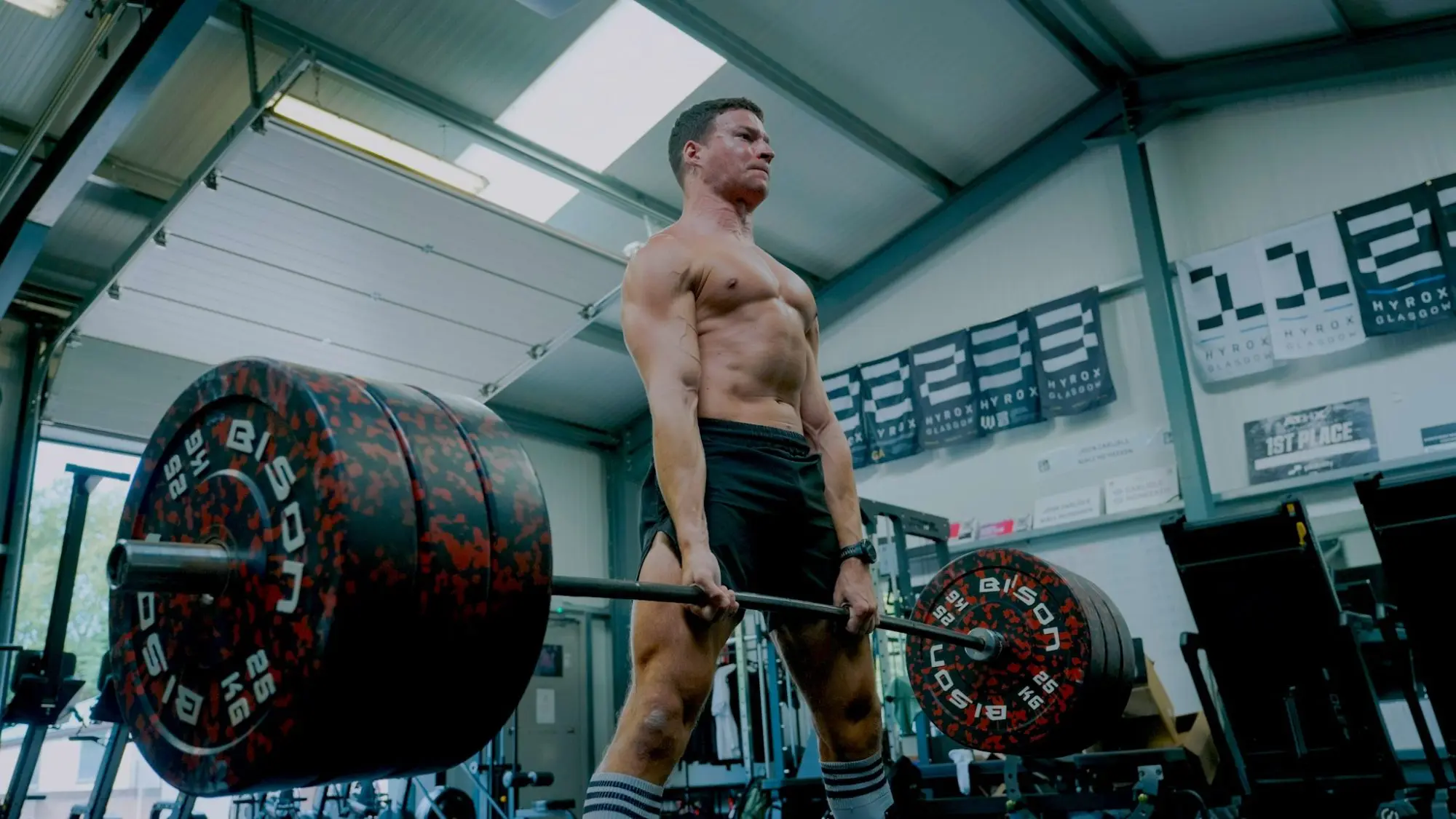
Hypertrophy: What’s Actually Worth Keeping
By James Blanchard
We’ve been coaching hybrid athletes for a long time now, and if there’s one thing that hasn’t changed, it’s this: the hypertrophy conversation online is noisier than it’s ever been.
The research on building muscle has come a long way in the last decade. The conversations have gotten better too – forums have moved from Facebook groups to Reddit threads to (if we’re allowed a little plug) the discussions happening daily in our own community. People are getting less wrapped up in dogma. But plenty of outdated ideas are still hanging around, and they’re quietly costing people progress.
The stuff that isn’t going anywhere
Train close to failure. This is the single most common thing people get wrong – and it’s rarely about laziness. It’s about effort being genuinely hard to judge. Your triceps ache, you’re breathing hard, your shoulder feels off – your brain registers “effort,” but that doesn’t mean the target muscle was actually challenged. The research is consistent: you want most sets landing within 1–3 reps of failure to drive meaningful growth. That doesn’t mean grinding every single set into the dirt – do that and your fatigue costs you performance later in the session. It just means stop leaving 6–7 reps in the tank as a habit. And knowing where you actually are relative to failure is a skill in itself — one that mostly comes from practice, and occasionally testing it on purpose so you know what a real 9 or 10 RPE feels like.
Progressive overload – but understand what’s actually driving it. Most people have the causality backwards. The heavier weight isn’t what causes the muscle to grow — it’s evidence that growth already happened. Your muscle adapts from the stress you applied and recovered from, and the bigger number on the bar is you catching up to where your body already is. Chase the number too aggressively and you end up grinding ugly reps or missing lifts just to hit a target that progressive overload “says” you should be hitting. Instead, ask a different question each session: has my capacity actually increased? Sometimes that shows up as more weight. Sometimes it’s the same weight with two more reps in reserve. Progress doesn’t have to be linear to be real.
Think in systems, not exercise rankings. “What’s the best exercise for X” is the wrong question. What actually builds muscle is repeatable, high-effort work that you can progress over time – the exercise is just the delivery mechanism. Better questions: does this let me load the target muscle properly? Can I execute it consistently with good technique? Can I keep doing it without breaking down? If an exercise irritates a joint or you can never standardise the technique, it doesn’t matter how well it ranks on some list – it’s not doing its job for you.
Full range of motion, most of the time. Training through a longer range tends to drive more hypertrophy than a shortened one, assuming technique holds up – more muscle tissue gets recruited and there’s more tension at end-range. That doesn’t mean turning every rep into a max stretch competition. It means: if you’re consistently cutting range short because the load’s too heavy or you’re rushing, you’re probably leaving adaptation on the table. Squat to depth. Let the bar touch on bench. Get the stretch on a lat pulldown. It matters.
What’s worth questioning – or dropping entirely
Training by feel instead of by output. This is probably the thing quietly undermining more people’s progress than anything else, and it doesn’t get talked about enough. “Did that exercise feel like it hit the muscle” is a subjective, day-to-day, sleep-and-stress-dependent measure — and it’s very easy to convince yourself a new variation is “better” just because it’s novel, not because it’s doing more work. What actually tells you training is working: are you doing more reps with the same weight than a month ago? Are you adding load over time? Chasing the pump instead of tracking output is how people end up cycling through exercise variations every few weeks and never actually know if they’re getting stronger at anything.
The rep-range obsession. You’ve heard it: 1-5 for strength, 8-15 for hypertrophy, 15-30 for endurance. It’s everywhere, and it’s largely wrong — or at least far less important than it’s made out to be. A set of 5 close to failure builds muscle. A set of 30 close to failure builds muscle. A set of 12 with six reps left in the tank builds very little, regardless of how perfectly it sits in the “hypertrophy range.” The real questions are: are you doing enough total volume, and are you actually giving the muscle a reason to grow? A sensible working range (roughly 6–20 reps for most lifts) gives you plenty of flexibility — use common sense for the rest.
Constantly rotating exercises to “keep the muscle guessing.” There’s a real cost to this that doesn’t get discussed enough. A big chunk of your early progress on any new exercise comes from motor learning — you’re getting more coordinated, not necessarily more muscular – so it feels like progress without being the same thing as tissue growth. Stick with a movement long enough to actually have a signal to track. Pick your bread-and-butter lifts (squat, deadlift, bench, overhead press, pull-up variations) and keep progressing on those consistently, then rotate accessories every 6–8 weeks if you need variety.
Using fatigue as a proxy for a good session. Being wrecked afterwards doesn’t confirm the session worked – you can be devastated by a session that barely stimulated growth, and feel totally fine after one that drove real adaptation. What matters is whether you trained the target muscle close enough to failure, with enough volume, in a way you can actually recover from and repeat. Managing fatigue well enough that your later sets — and later sessions in the week — are still worth doing is one of the most underrated skills in training, full stop.
Exercise order on autopilot. Most people default to “big compounds first, accessories after.” Fine in principle, but think about which movements accumulate the most systemic fatigue and whether that’s compromising what comes after. If a lift is particularly taxing for you – physically or mentally – everything after it in the session pays for it. Order with intent, not just habit.
The nuanced middle ground
Bench press is a great exercise – but it’s not automatically the best chest builder for everyone. It’s a multi-joint lift, and tricep/front-delt fatigue and shoulder blade positioning can all mean the chest gets less of the stimulus than you’d assume. A dumbbell or cable variation might do the job better for some people. Not a reason to drop the bench – a reason to think about what you actually want from it.
Lengthened-position training has some genuinely interesting research behind it, and it’s shifted how a lot of coaches think about exercise selection. But it’s become something people over-engineer machines for on Instagram. Worth factoring in as a tiebreaker between two similar exercises. Not a reason to reject everything that doesn’t hit peak stretch.
The bottom line
Train hard enough, close enough to failure. Do enough volume. Make sure it’s recoverable. Push it forward over time. That’s it – those principles aren’t going anywhere.
What can go: the rep-range obsession, constant exercise rotation, chasing the pump as a marker of quality, and the assumption that “hard” automatically means “productive.” Underneath almost all of it is the same mistake — paying more attention to how a session felt than to whether it actually produced more output over time.
The athletes who make consistent progress aren’t hunting for some optimal secret protocol. They’ve internalised a handful of principles, applied them consistently, stayed patient, and adjusted when something genuinely wasn’t working. Muscle growth takes a long time. There’s no way around that part.
Want this actually built into your training instead of just something you nod along to?
This is exactly the kind of thing our coaching team works through with athletes 1:1 – a programme built around your lifts, your recovery, and what’s actually working for you, adjusted as we go. If you want a coach in your corner who’s done the work themselves and will tell you straight what’s worth your effort and what isn’t, get in touch about 1:1 coaching.
Find out more about Omnia 1:1 Coaching here.
Or, if you’d like an introduction to hybrid training – you can download our free hybrid training guide here.
 How To Fuel Your Triathlon (Sprint + Olympic)
 How to Warm Up as a Hybrid Athlete
 The BEST Advice for Heavier Runners