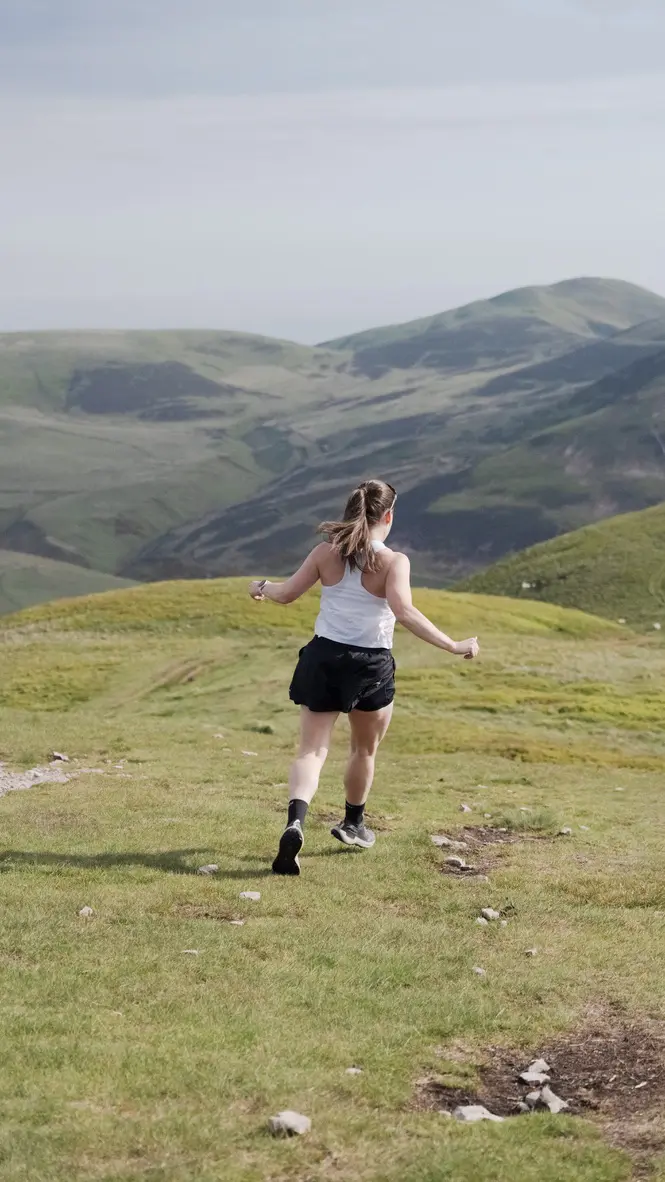
Road to Trail: What Nobody Tells You
By Kieran Richardson and Kelly Egan
Most people who get into trail running do it the same way.
They sign up for something that sounds fun. They rock up expecting it to feel like a road race with better scenery. And then the hills — or more accurately, the downhills – absolutely destroy them.
We don’t want that to be you.
Kieran, Head coach at OMNIA Performance, and Kelly, our Social Media Manager and endurance athlete, sat down to break down everything you actually need to know before making the switch from road to trail. This is the stuff that doesn’t make it onto Instagram.
It’s Not About Pace. It’s About Feel.
The first thing that catches road runners off guard is this: your watch becomes almost irrelevant.
On the road, you’ve got your pace, your heart rate zones, your splits. Trail running strips all of that away pretty fast. You’re climbing, you’re descending, you’re picking your way across technical terrain. You stop chasing numbers and start asking a different question – how do I actually feel right now?
That’s not a downgrade. It’s a shift. And for a lot of people, it’s the thing that makes trail running addictive. You’re present in a way road running rarely demands.
The other thing that changes is the muscle groups getting hammered. On the road, your body gets pretty efficient at repeating the same movement pattern. On trails, every single muscle in your legs is working — glutes, quads, calves, stabilisers you didn’t know you had. Going uphill loads the calves and Achilles in a way flat running simply doesn’t. Going downhill taxes your quads with a heavy eccentric load that will make you very sore, very quickly, if you haven’t prepared for it.
The Downhill Will Catch You Out
This is the bit people consistently underestimate.
Everyone knows going uphill is hard. Your heart rate spikes, your muscles burn, you can feel exactly how hard you’re working. But as you get deeper into a trail race, it’s the downhill that tends to blow people up – because you’re controlling your bodyweight on steep descents, over and over again, often for hours at a time. That’s a completely different kind of stress.
Kelly found this out the hard way in her first major trail race. Not enough downhill training, and she paid for it.
If you live somewhere flat, you can’t just rely on incline treadmill work. That conditions your calves and Achilles for the climb, but it does nothing for the descent. Add in eccentric-biased exercises – step downs, box step overs – to at least give your muscles some exposure to that kind of loading. It won’t fully replicate running downhill, but it’s a far better preparation than ignoring it entirely.
And if you can get out on actual trails with real descents? Do it. As early and as often as possible.
Walk the Hills. Seriously.
Here’s something that surprises a lot of people new to trail running: walking uphill isn’t giving up. For most athletes, it’s the faster option.
Trying to run up a steep trail in tiny shuffling steps is burning through energy you’ll desperately need later. Power hiking – hands on legs, driving yourself uphill – is more efficient, preserves your quads, and will leave you in better shape when you hit the back half of the race.
This is especially true for ultras. If you’ve only ever run marathons, the logistics feel similar – turn up, run, finish. But an ultra with significant elevation is a completely different beast. You might be out there for six, eight, ten hours. You cannot prepare for that purely by running.
Get the Miles on Your Feet – Without Running Them All
One of the most underrated pieces of trail and ultra training is also the simplest: just walk more.
Most people can’t routinely run for much more than three hours before the returns start diminishing. But an ultra might demand twice that, or more. So how do you bridge the gap?
You hike. You get long days on your feet in the hills. You alternate running and hiking across varied terrain and let your body adapt to just being out there for a long time. A six-hour day in the hills, where you’re walking half of it, is a completely different physiological demand to a six-hour run – and it’s one most people can actually recover from.
Kelly used to walk to work in Edinburgh – about an hour and a half each way. Three hours on her feet a day. People thought she was mad. Then she got to her ultra, conditions turned, the race ran long by hours, and she was fine. The feet had done the work.
Don’t underestimate the background miles. They earn you the resilience that racing will test.
Sort Your Kit. Then Sort It Again.
Trail running has an admin element that road running simply doesn’t.
On a road marathon, your kit list is simple. Race kit, gels, maybe a throwaway hoodie for the start line. That’s about it.
Out on the hills for six or ten hours, you’re in a different situation entirely. Weather can change in minutes. You can go from clear visibility to not being able to see 50 metres in front of you in the time it takes the clag to come in off the hills. Your phone battery will die exactly when you need it most.
At minimum, you want:
- A head torch – non-negotiable
- A windproof or emergency foil blanket – something packable that can make a dramatic difference to your warmth
- More food than you think you need – bonked strangers exist on trails too and you might be the only person they see for hours
- A whistle – and a backup
- Water and electrolytes – more than you’d plan for road running
- Someone who knows your route – not just where you parked, the whole route. Use Strava Beacon or similar so someone can track you
And if you’re heading somewhere genuinely remote: learn to use a paper map and compass. Not because you’ll necessarily need it. Because if you do need it and you don’t have it, you’re in real trouble.
Two is one and one is none. Always have a backup.
The Part Nobody Warns You About: You Might Love It
All of that might sound like a lot. And honestly, there is more to think about than road running.
But here’s the thing – when you get it right, trail running opens up a completely different relationship with the outdoors. You find yourself somewhere unexpected, somewhere quiet, somewhere that feels nothing like the city you live in, even when you’re technically still in it. You stop worrying about your kilometre splits and start noticing where you are.
Running through a canyon at sunrise. Crossing a ridge with the clag below you. Picking your way through terrain you’d never have found on the road.
That’s the payoff.
Ready to Take It Further?
If you want to add trail and ultra running into a structured training programme – one that balances the strength work, the aerobic base, and the specific demands of the events you’re chasing – that’s exactly what we do at OMNIA/
Find out more about Omnia 1:1 Coaching here.
Or, if you’d like an introduction to hybrid training – you can download our free hybrid training guide here.
 How To Fuel Your Triathlon (Sprint + Olympic)
 How to Warm Up as a Hybrid Athlete
 The BEST Advice for Heavier Runners